 English
  Português

Artificial intelligence is redefining how we test software. Development teams are discovering that AI is not just a generative tool: 39% of testers report improvements in test automation efficiency when using AI (Testlio, 2025). At the same time, 67% of professionals would trust AI-generated tests, but only with human review.
This data shows something important: AI in QA works, as long as you understand where it shines and where it still needs supervision. Let’s explore this duality clearly.
How AI is changing software testing
Traditionally, automating tests required a developer to write lines of code detailing each action. If the button changed location or name, the test would break.
With AI, the approach changes. Instead of programming each step, you describe the objective in natural language, which becomes a command that AI translates into functional tests. When the interface changes, it understands the context and adapts the test on its own.
This difference seems small on paper, but it has a huge impact in practice. A team that spends 60% of its time fixing broken tests (teams using Selenium and similar frameworks dedicate this percentage only to maintenance and debugging of unstable tests) can redirect that effort to create new scenarios or test critical functionalities.
Main advantages of using AI in QA testing
1. Accessible automation for non-technical teams
You know that product analyst who knows the business flows better than anyone but has never written a line of code? With AI, they can create tests.
Natural language description eliminates the technical barrier. A product manager can write “Check if a user can reset the password via email” and the AI automatically generates the complete scenario: navigation, clicks, validations, and error cases.
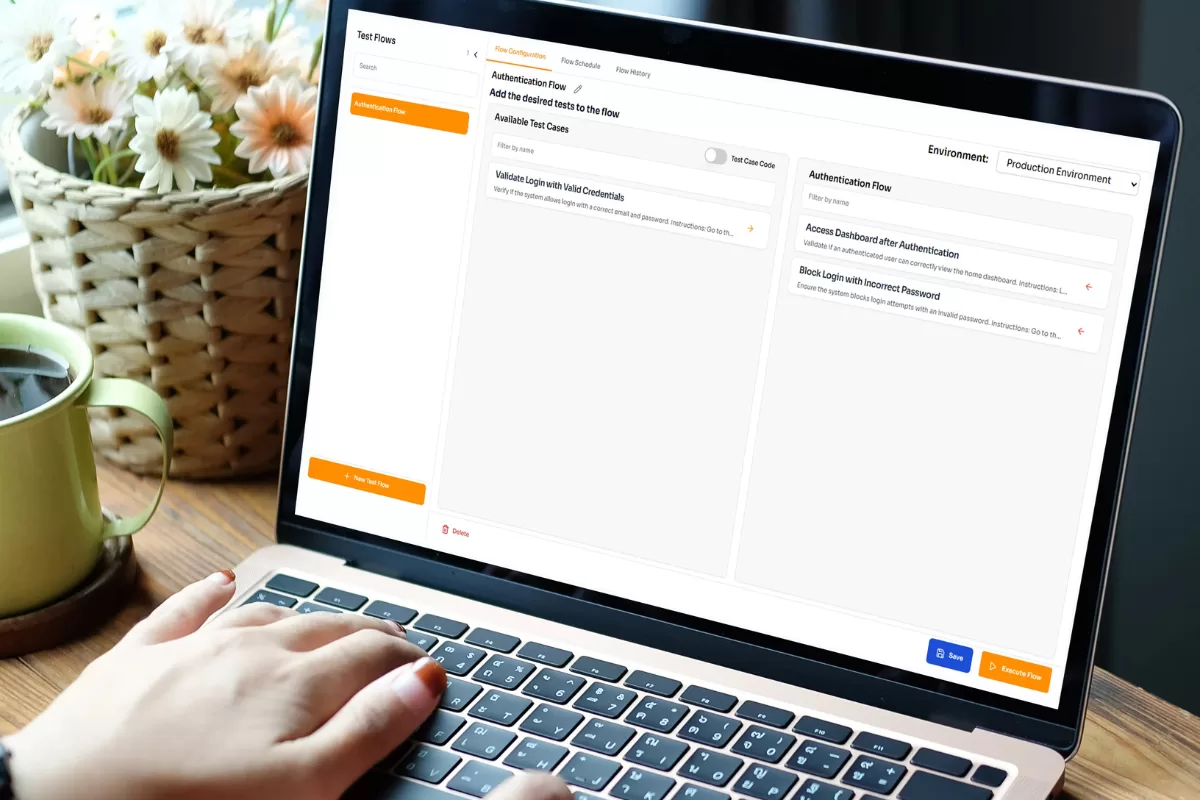
This democratizes QA. In TestBooster.ai, anyone on the team can describe a test in natural language and the platform translates it into functional automation.
2. More resilient and adaptive tests
Here’s a classic problem: the developer changes the field name from “age” to “date of birth” and 15 tests break. You spend the whole afternoon fixing scripts.
AI solves this by understanding context, not just fixed commands. Objective-based tests keep working even when interface details change. If the objective is “validate account opening,” the AI identifies relevant fields regardless of how they’re labeled.
This drastically reduces maintenance time. Platforms with native AI reduce maintenance overhead by more than 95% (Virtuoso QA), freeing your QA team to focus on strategy instead of fixing broken code.
3. Scalability and operational efficiency
AI allows you to run hundreds of tests in parallel without needing to proportionally hire more people. You schedule executions for the early morning, peak hours, or immediately after each deployment. The system runs on its own and delivers complete reports in the morning.

An e-commerce can simultaneously test the checkout flow on 5 different browsers, 3 mobile devices, and 2 operating systems. All while the team sleeps.
In TestBooster.ai, this scalability comes as standard. Configure once, run as many times as needed. The time saved translates directly into delivery speed.
4. Unified vision and business insights
Here’s the differentiator that goes beyond test execution: AI organizes data and generates insights understandable to all levels of the company.
Managers don’t want to know how many tests passed or failed. They need to understand: “Is the payment flow stable? Can our customers complete purchases without errors?”
AI translates technical data into strategic information. Dashboards show not just whether the test passed, but what the impact of a failure is on the business. A drop in the checkout test? That means potential revenue loss.
TestBooster.ai works as a quality hub that centralizes all the company’s quality initiatives. Fragmented reports are out, holistic vision is in.

Challenges of AI in testing
1. AI still needs human supervision
AI-generated tests need initial review.
If you vaguely describe “test the login,” you might get a test that only validates whether the button exists, without checking if login actually works. An experienced QA quickly identifies these gaps and refines the test.
Think of AI as a highly qualified assistant, not a total replacement. It accelerates repetitive work and scales coverage, but the critical eye of someone who understands the business context remains irreplaceable.
2. Initial learning curve
Learning to describe tests effectively takes a bit of time, like any other new process.
Teams accustomed to traditional automation need to shift their mindset: from “how do I execute this” to “what needs to work.” This transition has a learning curve.
3. Dependency on input data quality
AI generates tests based on what you provide. Vague description results in incomplete test.
“Test the registration screen” might generate superficial validations. “Validate that users can register with CPF, email, and password, including error cases like invalid CPF and weak password” generates complete scenarios.
The more context you give, the better the tests become. Over time, you develop intuition for writing descriptions that maximize output quality.
4. Not everything should be automated
Exploratory testing, UX validations, and user experience nuances still depend on humans.
AI works best on repetitive and critical flows: login, checkout, registration, payments. These processes have clear patterns and can be validated objectively.
Evaluating whether a design is intuitive or if an animation conveys the right message? That requires human judgment. Knowing where to apply AI makes all the difference in results.
When is it worth adopting AI in testing?
Some scenarios especially benefit from AI in QA:
- E-commerce and marketplaces have critical journeys (search, cart, payment) that need to work 24/7. A broken test at 2 AM can mean lost sales. AI ensures constant monitoring.
- Fintechs and digital banks can’t take risks with processes like account opening, transfers, or investments. Adaptive tests validate these flows even when regulations change and interfaces need updating.
- SaaS companies that constantly launch features benefit from speed. Companies using AI-native tests deliver features 85% faster than teams using traditional automation.
- Organizations scaling QA without proportionally increasing the team find in AI the necessary productivity lever. 26% of teams have already replaced up to 50% of manual tests with automation, and 20% have replaced 75% or more.
What to expect from AI in QA going forward
AI in software testing is maturing rapidly. According to Gartner, by 2028, 33% of enterprise applications will include agentic AI, allowing 15% of daily work decisions to be made more autonomously.
This means testing will evolve from “executing commands” to “understanding objectives and making decisions.” AI will identify not just whether something broke, but why it broke and how to fix it.
That said, human supervision will remain essential. Regardless of how autonomous AI becomes, a certain level of human oversight will always be necessary.
The best strategy? Embrace AI where it already delivers value, keep humans in the loop for critical decisions, and stay attentive to constant evolutions.
AI in QA ensures efficiency, visibility, and confidence
AI in software testing has real limitations. It’s not a magic solution that solves everything on its own. It needs supervision, has a learning curve, and works best in specific contexts.
That said, the advantages outweigh the challenges when well implemented. Democratizing test creation, reducing maintenance by 95%, executing hundreds of validations in parallel, and translating technical data into business insights are concrete gains.
The global AI-enabled testing market is projected to grow from $643.5 million in 2022 to $2.746.6 billion by 2030. Companies adopting early are not just improving processes but building competitive advantage.
If you want to understand how AI can transform your software testing without discarding what already works, get to know TestBooster.ai. The right combination of intelligent technology and strategic supervision is just one click away.